Friday, May 24, 2013

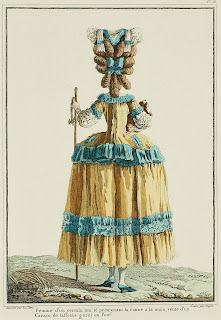
Galerie des Modes, 39e Cahier (bis 2), 3e Figure

 Young Person in indolent négligée with a simple Fourreau d'Agnes, amadis sleeves, triple Kerchief, Ribbon Necklace, and Globe Cap; having an air of braving the heat of the Sun as much as the fires of Love. (1784)

Globe Cap. - "The aerostatic discoveries did not fail to furnish a number of ingenious names for fashions.  The only Galerie des Modes provides much evidence of this.  In addition to this plate, which dates to 1784, others from the same year show the globe ribbon (pl. 176), the globe hat (pl. 188), the hat à la Montgolfier (pl. 190), the demi-balloon hat (pl. 197), the hat à la Blanchard (pl. 199), the Globe cap (pl. 202).  Furthermore, the twelfth and thirteenth books of coiffures, for [1785], show the aerostatic balloon hats worn in 1783, à la inflammable air, au flying globe, au Robert's globe, etc.

"To be precise, note that the first attempt of the Montgolfier brothers was on the 5th of June [1783]; that of Robert was on the 1st of December in the same year and that of Blanchard in January 1785."

---

We tend to use the term "fourreau" in relation to the vertical pleats used on the back of a gown, but I find that it appears most frequently in period texts as the name for a child's back-closing gown.  The uses with adult clothing are mostly ambiguous, but in this case it's clearly in reference to a woman's gown with no front opening in the skirt.  It's possible that the bodice fastens in the back, like the children's garment, but this could also be a front-closing gown with an apron-front skirt.

"Agnes" is a character from Moliere's School for Wives, an innocent young girl brought up in a convent, so this dress might be intended to evoke charming simplicity.  I haven't found any other likely Agnes to have lent her name to the gown, but perhaps I will come across one while researching something else in the future.

This version of the plate is from the MFA Boston, 44.1567.

Thursday, May 23, 2013

Galerie des Modes, 39e Cahier (bis 2), 2e Figure

Lady, a sincere and faithful friend, with a Gown and Petticoat à l'Anglo-Americaine,* edged elegantly with a different fabric, fitted sleeves, Ribbon bow and tour-de-gorge à la Gabrielle d'Etrées,** playing with her Dog while waiting for better. (1784)


"One could advance, without fear of being contradicted, that it is hardly usual today for women to wear the full parure than for men to wear suits à la française ...

"Women no longer wear the full hoops which gave them an immense breadth, or those gowns with trains that trail for an ell on the ground: in the poorest parures, even wool suits are simplified (we make an exception for court suits which never vary and which can only remind us still of the suits of our fathers).  Everything is changed, women are no longer coiffed en cheveux: they wear hats or caps.  Their throats and necks are no longer uncovered.  No more the 'false rump'; they hardly wear little coudes† with pockets to give a certain fullness.  All apply today to have a svelte and nimble waist.  All that has been conserved of the former look are the stays, to narrow the waist, and the grand trimmings of the gown."

Le Cabinet des modes, 15 May 1786‡

* Americans of the former English colonies
** Gabrielle d'Estrées (1573-1599) was a mistress of Henri IV.  Apart from the famous nipple-pinching portrait, she was usually painted with a fashionable while ruff, which the tour-de-gorge is presumably supposed to resemble.
† literally "elbows", probably referring to a very small hip roll or tournure
‡ Originally this was "1876", but from the text it sounds like there is an error in the printing.

Tuesday, May 21, 2013

Galerie des Modes, 39e Cahier (bis 2), 1ere Figure

Lady in beautiful Morning dress, with white and trimmed Gown and Petticoat, silk Muff, spotted Gauze Mantelet, Coiffed over a half-Baigneuse with a demi-Globe hat and thinking of the end of the Day, to that which occupies the Night. (1784)


"On the method by which women draped their mantelets, the Journal de Paris of February 12 1781 reports a curious anecdote, which it took from the Morning Chronicle.  A French gentleman had written to the editor of the latter newspaper that at a ball, in London, he had found on land 'a woman's cloak, of black taffeta, lined with the same and edged with lace.'  And he added maliciously: 'measuring, carefully, the length between the top of the cloak, in the back, and the pleats or horizontal crumpling formed around the bottom of the waist, by the force of the cloak when the person tightens it in the French manner to elevate her stature and when she gathers the whole upper part at the hips while the lower part, trimmed with lace, falls and floats with softness over a rounded and strongly pronounced croupe*, there is not a single admirer who hadn't decided, as I made it, that the bust being soaring, the person is tall and well made ..."

* a cul, a bouffante, a bum roll

Monday, May 20, 2013

Galerie des Modes, 39e Cahier (bis), 6e Figure*

* There are two 39e Cahier (bis)es.  The first one is five coiffure plates and a fashion plate, the second is all dress.  I'm sorry, I'm confused too.

Lady dressed in a very elegant grand Domino to go to a masked Ball. (1784?)

This domino differs very little from that of plate 86, to which we return for the explanation of the successive forms of this fancy dress for its variations for masques.

We note, however, the difference in hairstyles; the use of felt hats, positioned on the lower and lower coiffures, extend even to ball toilettes.

Friday, May 17, 2013

Galerie des Modes, 34e Cahier bis, 6e Figure

Simple robe à la sultane, such as is actually worn without a grand parure.  This gown is open in front and allows the whole petticoat to be seen; in the back it has the form of an untied polonaise and descends almost to the ground like the Lévite.  Hat coiffure with a cap of Gauze invented by Mlle Bertin. (1782)


This plate is from the Museum of Fine Arts Boston, 44.1525.

Thursday, May 16, 2013

Galerie des Modes, 34e Cahier bis, 5e Figure

Young Lady performing a dance; she is dressed in a Carmelite* morning Lévite, the Trim of the same fabric, the Collar gathered muslin with a large hem, petticoat of pale pink silk trimmed with the same, white Belt with colored fringe. (1782)


Dance. - "One dances no more at the Opera ball; one no longer runs there; one only looks for confusion there: one walks on one's feet; one is smothered: here is the great pleasure: but no contre-danses.

"Dancing is so perfected today that it is necessary to dance with a marked superiority to participate.  When Marcel, his head supported on one of his hands, wrote: What things in a minuet! did he himself anticipate that soon it would no longer be permitted to dance for one's own pleasure, that the man of the world would become an actor in a bal paré,** and that he would dance for applause?"

Sébastien MERCIER, Tableau de Paris, ed. 1785

* The Carmelites are a Catholic order dating back to the 13th century, who traditionally wear brown.
** I'm not quite sure how to translate this one - I know that paré frequently means "dressed" in the sense of "fully-dressed" or "dressed to be seen". The women in the print below are dressed well, but not in robes parées

Le Bal Paré, Antoine Jean Duclos, 1774; MMA 33.56.33

Wednesday, May 15, 2013

Galerie des Modes, 34e Cahier bis, 4e Figure

Morning robe à l'Anglaise with amadis sleeves, coupé petticoat with a large volant of muslin, kerchief with double row of trimming.  This woman is coiffed with a hat of long-haired Vicuna with a ribbon around it. (1782)

This plate is from the Museum of Fine Arts Boston, 44.1547.